Guitar Triads – Unlock the Fingerboard

Learning the guitar and not sure how to go about learning the fingerboard? A lot of teachers start students with scales (if you are unlucky, they’ll give you a sheet with SEVEN modes with Greek names). That’s what my guitar instructor did when I was 13 years old and I couldn’t even play a basic chord change or even a single tune. Talk about scratching my head!
Perhaps you learned a bunch of scales and now everything you play sounds only like scales. This approach can help.
What I’m presenting here is one of the very first things I give all of my guitar students. I start everyone with guitar triads.
What does Triad mean? Triad means something involving THREE of course. So, what you are doing is playing only the three notes that make up the major chord (no doubles like you do with your open “strumming” chords).
A major chord is made up of the 1-3-5 of the corresponding major scale. Those are the only three notes you are playing.
If you learn these guitar triad shapes really well, you’ll later see how this can lead to you being able to create melodies and improvise at will up and down the guitar fingerboard. In short, the notes within the chord, aka CHORD TONES, are the safest notes you can play behind each chord. Therefore, it behooves you to know where they’re located.
Guitar Triads Shapes
I am using G major in this example. Each are moveable up and down the fingerboard.
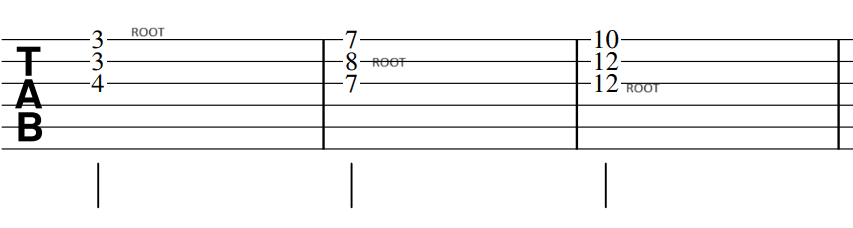
The notes marked “root” are the 1 of the chord. It is telling you where the G note is for each shape (you need to know this).
Guitar Triad Fingering notes:
SHAPE 1: The root is on the top string. Barre the 3rd fret with your index finger and use your middle finger on the 3rd string
SHAPE 2: The root is on the 2nd string. Middle finger on the 1st string, ring finger on the 2nd string, and index finger on the 3rd string (Some of you may recognize this as the D chord shape you’ve played before)
Shape 3: The Root is on the 3rd string. Index finger on the 1st string, pinky on the 2nd string, and ring finger on the 3rd string.
How to learn and use Guitar Triads
What you want to do is:
- Learn each shape
- Learn where the Root or 1 is in each shape (memorize this)
- Knowing where the root is, now derive the 3rd of the chord
How do you know where the 3rd is? It is always one string higher across from the root or one. In the case of shape 1, there’s no higher string from the root, so it kicks back over to the third string.
In a later article, I will show to use this information to find your minor chords and how to use them to solo over chord changes with (without thinking too much about scales, modes, and other more complicated ideas).
If you are looking for more work, try to find your C and D major triads using these shapes (there are three of each just like for the G chord).
Next, you can move on to my guitar major arpeggio guide to increase your fingerboard knowledge.
Looking for an online guitar teacher? I teach bluegrass, jazz, fingerstyle arranging, songwriting, and more. Contact me and let’s help you reach your musical goals.